
Why Vancouver’s New Smart Home Technology Is Creating Unexpected Exterior Cleaning Challenges (And How Pressure Washing Protects Your High-Tech Investment)
Worried about your expensive smart home devices getting damaged by Vancouver’s salty coastal air and unpredictable weather? You’re right to be concerned – the same ocean breeze that makes our city beautiful is quietly destroying your high-tech investments, and most homeowners have no clue it’s happening until it’s too late.
Picture this: you’ve just dropped $800 on a shiny new Ring video doorbell and matching security cameras to protect your Vancouver home. Six months later, the camera lens is fogged up, the doorbell stops responding, and your smart outdoor lights are flickering like a haunted house decoration. What went wrong? Welcome to Vancouver’s dirty little secret – our gorgeous coastal location creates a perfect storm of salt air, moisture, and temperature swings that absolutely demolish smart home technology faster than anywhere else in North America.
I learned this the hard way when my neighbor’s two-year-old security system started malfunctioning after what seemed like a routine rainy season. Turns out, Vancouver’s salt air doesn’t just stay at the waterfront – it travels up to 25 kilometers inland, meaning homes in Burnaby, Richmond, and Surrey are just as vulnerable as those oceanfront properties in West Van. The kicker? Traditional pressure washing techniques that work perfectly fine for cleaning driveways and siding can actually make smart device problems worse if you don’t know what you’re doing.
Smart home technology is supposed to make our lives easier and our homes safer, but without proper maintenance that accounts for Vancouver’s unique environmental challenges, we’re essentially watching our high-tech investments slowly corrode from the inside out. The good news is that professional exterior cleaning services are finally catching on to this problem, developing specialized techniques that protect smart devices while still keeping your home looking pristine.
Key Outtakes:
- Vancouver’s salt air reduces smart device lifespan by 20-40% compared to inland areas, making professional exterior cleaning essential for protection
- Condensation and moisture accumulation inside security cameras and smart devices is a primary failure point during Vancouver’s temperature fluctuations
- Smart outdoor devices like video doorbells and security cameras require IP65-IP67 waterproof ratings, but only 46% of homeowners have any smart technology installed
- Pressure washing and soft washing techniques differ dramatically – using the wrong PSI (1,300-4,400 range) can destroy smart devices or fail to clean them properly
- Professional exterior cleaning services that understand smart device vulnerabilities are more critical than DIY pressure washing for protecting high-tech home investments

Vancouver’s Coastal Environment Creates a “Smart Device Corrosion Crisis”
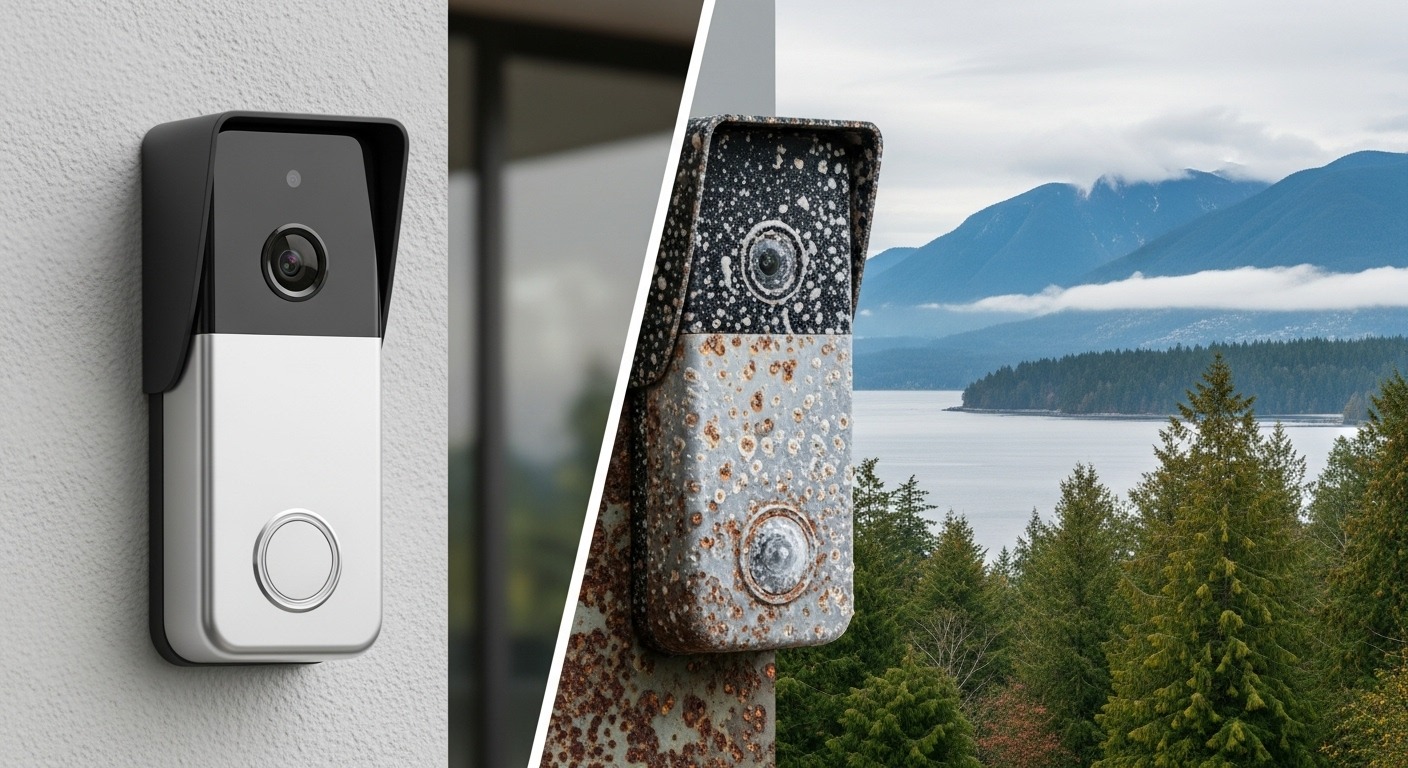
You might think living in Burnaby or Surrey protects your smart home devices from ocean damage, but Vancouver’s coastal reality is far more insidious than most homeowners realize. Salt particles from ocean spray don’t politely stop at the shoreline – they travel up to 25 kilometers inland on prevailing winds, creating what researchers call an “invisible corrosion zone” that affects the entire Lower Mainland. This means your expensive smart thermostat in New Westminster is just as vulnerable to salt air damage as a security camera mounted on a Kitsilano beach house.
The science behind this destruction is surprisingly brutal. Salt air doesn’t just coat surfaces – it actively accelerates something called “pitting corrosion” that literally eats through metal components from the inside out. When salt particles land on your smart devices, they immediately begin attracting moisture from the air, creating electrolytic conditions that promote galvanic corrosion between the different metals (copper, aluminum, steel) found in modern electronics. This process reduces appliance and smart device lifespan by 20-40% compared to similar devices in dry, inland locations like Calgary or Winnipeg.

What makes Vancouver particularly devastating for smart home technology is our “triple threat” environmental combination. While homeowners in Phoenix might pressure wash once yearly, Vancouver residents face salt air plus persistent high humidity exceeding 60% during our rainy season, plus freeze-thaw cycles that create temperature stress on electronic components. These three factors work together synergistically, meaning the combined damage is actually worse than the sum of its parts. Your smart devices aren’t just dealing with salt – they’re dealing with salt-accelerated corrosion in a high-moisture environment with constant thermal cycling.
The damage patterns are predictable once you understand the process. HVAC systems draw salt-contaminated outdoor air through intake systems while managing high indoor humidity, creating perfect conditions for copper-aluminum galvanic corrosion inside your expensive smart thermostats. Refrigerator and freezer condenser coils act like giant air filters that trap salt particles, and when coated with salt-contaminated dust, they force compressors to work 30% harder while dramatically shortening operational lifespan. Smart outdoor lighting fixtures and security cameras suffer the most because their metal housings and electrical connectors are directly exposed to salt spray during our frequent coastal storms.
This isn’t just theoretical damage we’re talking about. Real appliance repair data from Vancouver shows that coastal salt air creates measurable corrosion acceleration that homeowners can see in their utility bills and repair frequency. The molecular process begins the moment ocean spray contacts metal components, with salt particles creating ongoing electrolytic reactions that never stop until the device fails completely.
Moisture, Condensation, and the Invisible Smart Device Killer

While salt air gets the attention as Vancouver’s smart device destroyer, there’s an even sneakier culprit that kills expensive security systems and smart sensors: internal condensation. This process is so subtle that most homeowners never see it coming until their previously perfect security camera suddenly develops a fogged lens that makes it useless for actually, you know, providing security. The trigger isn’t dramatic flooding or storm damage – it’s Vancouver’s frequent temperature fluctuations between chilly nights and mild days that create expansion and contraction cycles in device housings.
Here’s what actually happens inside your smart devices during a typical Vancouver weather pattern. When temperatures drop overnight, metal components in camera housings and smart sensors contract slightly, creating microscopic gaps in weatherproof seals. When morning temperatures rise, these components expand again, but the repeated cycling gradually loosens connections and creates permanent pathways for moisture penetration. Once humid air gets inside a device housing, temperature changes cause that moisture to condense on internal electronics, creating exactly the conditions that short-circuit expensive circuitry.
One of the most frustrating examples of this invisible damage shows up in security cameras that work perfectly for years before suddenly developing internal fogging. Real homeowner experiences show cameras that functioned flawlessly for six years before condensation sealed moisture inside the housing, rendering the entire security investment worthless. Anti-fogging sprays might temporarily improve vision through fogged lenses, but they don’t address the underlying moisture problem that will eventually damage internal circuitry beyond repair.
The condensation problem becomes particularly critical when you consider that professional pressure washing with proper technique can actually prevent these failures by keeping camera lenses and housings clean and free from salt-contaminated residue that attracts atmospheric moisture. However, DIY pressure washing with incorrect PSI settings forces water deep into device seals, actually accelerating condensation problems rather than preventing them. This creates a maintenance paradox where improper cleaning makes the problem worse, while proper cleaning prevents it entirely.
Temperature cycling doesn’t just affect outdoor cameras – it impacts any smart device that experiences Vancouver’s daily temperature swings. Smart thermostats can suffer internal condensation when warm indoor air meets cold mounting surfaces during winter months. Even minor water exposure to smart thermostats causes electrical shorts or corrosion, rendering heating and cooling control systems inoperable and leaving homes at genuine risk during our winters. Smart security systems including door sensors and alarm components fail when exposed to moisture, with sensors stopping functionality entirely and compromising home security.
The science behind moisture damage explains why pure water isn’t the real threat – contaminants are. Pure water is non-conductive, but the contaminants found in Vancouver rainwater including dust, industrial emissions, and those omnipresent salt particles create electrolytic conditions that short-circuit electronics. As this Bulgin blog explains, this contaminated moisture creates a conductive path that leads to short circuits and permanent electronic failure.
Pressure Washing vs. Soft Washing: Why Using the Wrong Technique Is a Recipe for Disaster

Here’s where things get really critical for Vancouver homeowners. You see the grime building up on your siding and that green tinge of algae on your new Ring doorbell, so you pull out your weekend warrior pressure washer, thinking you’re solving the problem. In reality, you’re about to deliver a high-pressure death sentence to your expensive smart devices. Standard pressure washers operate between 1,300 and 2,800 PSI (pounds per square inch), a force designed to strip stubborn stains from concrete, not gently clean sensitive electronics.
Most smart home devices, including popular brands like Ring, Nest, and Arlo, have an IP (Ingress Protection) rating between IP65 and IP67. An IP65 rating means the device is protected against low-pressure water jets from any direction, while IP67 means it can be submerged in 1 meter of water for 30 minutes. Notice what’s missing? Protection against high-pressure water jets. Blasting an IP65-rated camera with 1,500 PSI of water is the equivalent of hitting it with a fire hose – you’re forcing water past the weatherproof seals and directly into the electronic components you’re trying to protect.
This is why professional exterior cleaning has shifted towards soft washing for homes with smart technology. Soft washing is a completely different methodology that uses specialized cleaning solutions to kill algae, mold, and dissolve grime, followed by a low-pressure rinse that’s no stronger than a garden hose (typically under 100 PSI). It’s powerful enough to remove the corrosive salt and dirt but gentle enough that it poses zero risk to your smart doorbell, security cameras, or outdoor lighting. It cleans more effectively and with far greater safety than high-pressure methods.
| Technique | Pressure (PSI) | Best For | Smart Device Safety |
|---|---|---|---|
| DIY Pressure Washing | 1,300 – 2,800 PSI | Concrete driveways, stone patios (with caution) | Extremely Unsafe. High risk of forcing water past seals, causing immediate or long-term failure. |
| Professional Pressure Washing | 2,000 – 4,400 PSI | Heavy-duty commercial cleaning, paint stripping | Completely Unsafe. Will destroy most consumer electronics on contact. |
| Professional Soft Washing | 40 – 100 PSI | House siding (vinyl, stucco, wood), roofs, fences, and all smart home devices | Completely Safe. Gently rinses away contaminants without compromising weatherproof seals. The recommended method. |
FAQs About Pressure Washing and Smart Home Technology
Q: Can I just use my own pressure washer on a low setting for my smart devices?
A: It’s extremely risky. Consumer-grade pressure washers often lack precise PSI control, meaning even the “lowest” setting could exceed the 500-800 PSI safe zone for electronics. Without proper nozzles and techniques, you can easily force water past weatherproof seals, causing more damage than you prevent. Professional services use specialized soft washing equipment that delivers a high volume of water at very low pressure, which is much safer for delicate electronics and surfaces.
Q: How often should I have my home’s exterior and smart devices professionally cleaned in Vancouver?
A: For optimal protection in Vancouver’s high-salt, high-moisture environment, we recommend professional exterior cleaning at least once per year. For homes within 5 kilometers of the coast, a twice-yearly cleaning schedule (spring and fall) is ideal to prevent salt and grime buildup from causing permanent corrosion damage to your smart home technology and other exterior surfaces.
Q: Is soft washing actually effective at removing salt and grime?
A: Yes, and it’s often more effective than high-pressure washing. Soft washing relies on specialized, eco-friendly cleaning solutions to break down salt, algae, mold, and grime at a molecular level. The low-pressure rinse that follows gently removes all the contaminants without any risk of damaging your home’s siding, seals, or expensive smart devices. It cleans more thoroughly and safely than high pressure alone.
Wrapping Up: Protecting Your High-Tech Home in a High-Moisture World
Your smart home is a major investment in your property’s safety, convenience, and value. But in Vancouver’s unique climate, that investment is under constant, invisible attack from the very air around it. Simply installing expensive devices isn’t enough; they require specialized maintenance to survive. Ignoring the corrosive effects of salt and moisture is a guaranteed way to shorten the lifespan of your technology, leading to frustrating malfunctions and costly replacements.
The solution isn’t to abandon smart technology, but to protect it intelligently. By partnering with a professional exterior cleaning service that understands the vulnerabilities of smart devices and employs safe, effective soft washing techniques, you’re not just cleaning your home—you’re preserving your high-tech investment for years to come.
